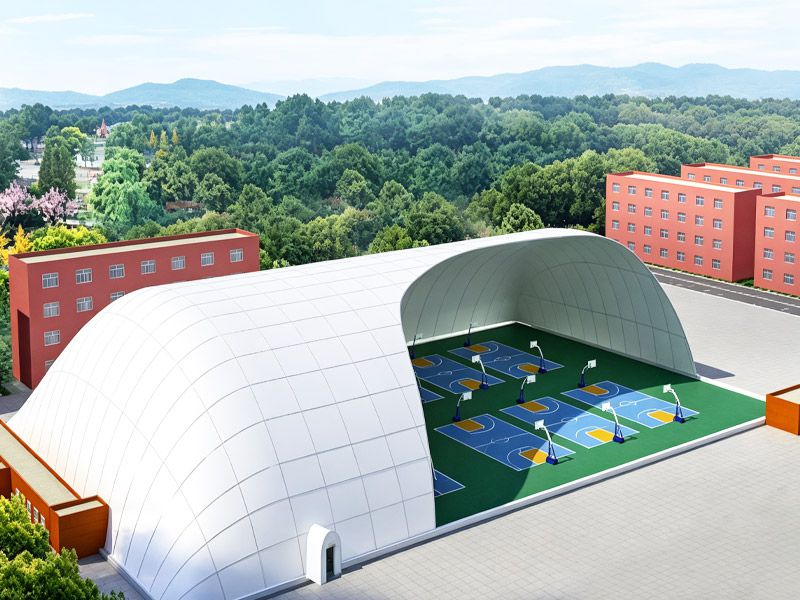
How do air-supported buildings solve sound insulation and thermal insulation problems?
As a new building form with membrane material as the shell and internal air pressure to maintain its form, the sound insulation and thermal insulation performance of air film building directly determine the comfort and energy efficiency of use. In response to these two core problems, the industry has formed a complete set of solutions through material innovation, structural design and system optimization, which are analyzed from the technical level as follows:
1. The path to the realization of thermal insulation performance
The thermal insulation demand of air-film buildings mainly stems from the impact of external ambient temperature fluctuations on the interior space, and its solutions revolve around two major directions: "reducing heat transfer" and "actively adjusting temperature":
1. Thermal insulation design of composite membrane materials
The core material of the air film building is PVC or PTFE membrane, which improves the thermal insulation capacity through a multi-layer composite structure. For example, PVC membrane materials usually adopt a three-layer structure of "base fabric, thermal insulation sandwich layer, and protective coating": the base fabric provides mechanical support, and the middle sandwich layer (such as closed-cell foam, glass wool) uses its low thermal conductivity to block heat conduction; PTFE films enhance the reflection of solar radiation by adding ceramic particles or aluminum foil reflective layers. The data show that the heat transfer coefficient (K value) of composite insulation membrane can be as low as 1.2~1.8 W/(m²· K), which is much better than that of ordinary single-layer membranes (K value is about 3.5 W/(m²· K))。
2. Thermal insulation and buffer of the air layer
The positive pressure maintained inside the air membrane forms an air cavity with a thickness of tens of centimeters or even several meters, and air is a poor conductor of heat (thermal conductivity is only 0.026 W/(m·K)). This air cavity is equivalent to a natural insulation layer, which can effectively reduce the heat exchange between hot and cold air from the outside and the internal space. For example, in winter, the air cavity blocks the intrusion of external low temperatures; In summer, heat penetration is delayed and air conditioning load is reduced.
3. Reflective coating and intelligent shading
The surface of the film is coated with a highly reflective material (such as aluminum foil layer), which can reflect more than 80% of the sun's infrared rays and reduce heat absorption. Some air films are also integrated with intelligent shading systems, which automatically adjust the light transmittance of sunshades or membranes through sensors to further control the amount of solar radiation inlet.
4. Internal insulation lining and ventilation system
For extreme climate areas, glass wool, polyester fiber and other insulation linings (thickness 5~10cm) can be added to the inside of the air film to further reduce heat transfer. At the same time, a replacement ventilation system is adopted: fresh air is sent in from the bottom and hot air is discharged from the top, forming an airflow organization of "cold at the bottom and hot at the top", reducing energy consumption while maintaining a comfortable temperature.
2. Technological breakthrough in sound insulation performance
The challenge of sound insulation in air-membrane buildings is that the flexible nature of the membrane itself is easy to transmit sound waves, and the solution needs to combine "blocking external noise" and "absorbing internal echoes":
1. Sound wave blocking with multi-layer membrane structure
It adopts a double-layer or three-layer membrane structure, with an air layer of 10~20cm in the middle, and uses the difference in acoustic impedance of the air layer to block the propagation of sound waves. For example, the double-layer membrane structure can isolate 25~30dB of external noise (equivalent to reducing traffic noise from 65dB to 35~40dB). If the air layer is filled with sound-absorbing materials (such as rock wool), the sound insulation effect can be improved to 35~40dB.