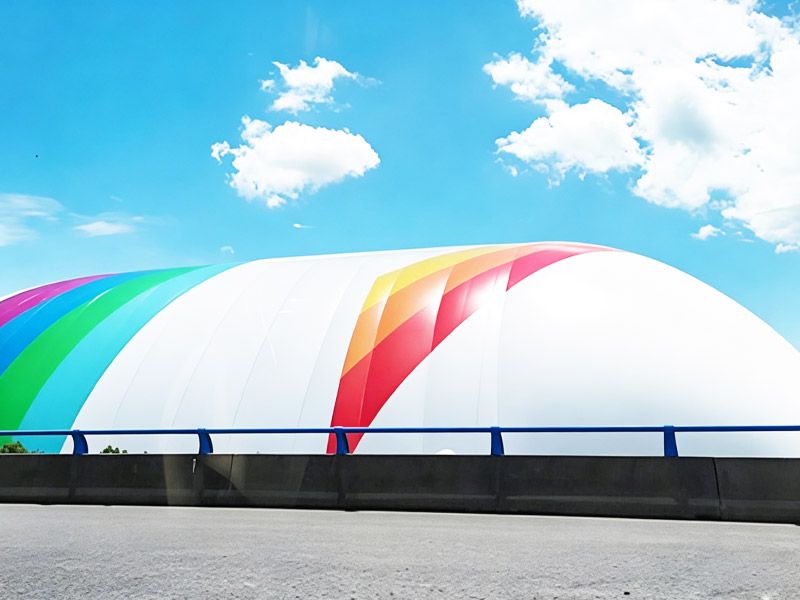
Why air-supported buildings are suitable for large event venues
In recent years, air-supported membrane buildings have gradually become a new choice for organizers in the field of large-scale events due to their unique structural advantages. From concerts and exhibitions to temporary sports events, air-supported membrane buildings adapt to the diverse needs of large-scale events with their flexibility and environmental friendliness. The following analyzes their adaptability from core dimensions:
1. Large-span column-free space: freeing up layout flexibility
The core spatial demand for large-scale events (such as concerts and exhibitions) is an "open and unobstructed" space. Traditional buildings are limited by beam and column structures; large-span spaces often require column supports, which obstruct views and restrict the flexible arrangement of booths and stages. Air-supported membrane buildings, however, use internal air pressure differences to support the membrane, eliminating the need for any internal columns and achieving continuous spaces spanning hundreds of meters.
For example, a concert for tens of thousands of people requires a panoramic stage and an audience area with no dead angles. An air-supported venue can provide a clear view for those in the back rows; for exhibitions, a column-free space allows for flexible booth division, avoiding interference from columns with the display of exhibits and enhancing the attendee experience. This kind of "fully open" space is difficult for traditional venues to match.
2. Quick assembly and disassembly: meeting temporary event requirements
Large-scale events are often short-term (lasting a few days to a few weeks). Traditional venue construction can take months, making it unable to meet the needs for temporary setup. Air-supported membrane buildings adopt a modular design with very high assembly efficiency: a venue covering several thousand square meters can be installed in just 3-7 days, disassembled just as conveniently, and without causing damage to the site.
For example, if a temporary sports event needs to quickly set up a venue in a remote area, air-inflated structures can be erected in a short time to ensure the event proceeds as scheduled; after the festival or event ends, the air-inflated structure can be quickly dismantled, restoring the site to its original state and reducing the impact on the surrounding environment. This 'build and use immediately' feature is suitable for temporary activities.
3. Cost Effectiveness: Reducing Operational Burden
The construction cost of traditional large venues is high (several thousand to tens of thousands of yuan per square meter), and maintenance costs are considerable; renting a fixed venue for a short period often also exceeds the budget. Air-inflated structures have significant overall cost advantages:
- Low construction cost: The cost of membrane materials and supporting systems is only 1/3 to 1/2 that of traditional buildings;
- Low operating cost: The membranes have good sealing and thermal insulation properties, reducing air conditioning energy consumption by over 30% compared to traditional buildings;
- High reusability: The membrane materials can be recycled and maintain performance after multiple assemblies and dismantlings, reducing long-term usage costs.
For example, for a one-week exhibition, the overall cost of an air-inflated venue is only one-third that of a traditional venue, greatly alleviating the financial pressure on the organizers.
4. Strong Environmental Adaptability: Resisting Complex Weather Interference
Large outdoor events are easily affected by weather (such as heavy rain, strong winds, high temperatures). The membrane materials of air-inflated structures are waterproof, windproof, and UV-resistant: they can withstand winds of level 12 or above and heavy rain, and the UV coating on the membrane surface can filter over 90% of ultraviolet rays; internally, an intelligent control system adjusts temperature, humidity, and ventilation to ensure the event takes place in a comfortable environment.
For example, at a summer outdoor music festival during a sudden rain, the air-inflated venue can provide a dry and cool space; during winter ice and snow activities, the interior can maintain a suitable temperature, preventing participants from being affected by the cold. This 'all-weather' guarantee allows events to proceed without cancellation or compromise due to weather.
5. Environmental Sustainability: Aligns with the Concept of Green Events
Nowadays, large-scale events are increasingly focused on "green exhibitions," and the eco-friendly features of air-supported structures perfectly align with this trend:
- Recyclable Materials: Membrane materials (such as PVDF membranes) can be recycled, reducing construction waste;
- Low Carbon Emissions: The construction process does not involve concrete pouring, and energy consumption is only half that of traditional buildings, lowering the carbon footprint;
- Eco-Friendly: Temporarily constructed air-supported venues do not damage the original ecology of the site and can be restored after dismantling.
For example, an environmentally friendly exhibition chose an air-supported venue as its main site, which not only matched the theme of the exhibition but also practiced green concepts through concrete actions, receiving unanimous praise from attendees.
6. Safety and Versatility: Meeting Diverse Event Needs
The safety and versatility of air-supported structures further enhance their adaptability:
- Structural Safety: Flexible structures can disperse external forces, resist wind and earthquakes; internally equipped with fire protection systems, emergency lighting, and ventilation systems, meeting national safety standards;
- Functional Flexibility: Spaces can be quickly divided according to event needs (e.g., speaking areas, exhibition areas, interaction zones) and can also be converted into sports venues, concert halls, and other scenarios, making full use of the space.
Conclusion
With their large-span column-free spaces, rapid construction capability, cost-effectiveness, environmental adaptability, eco-friendliness, and safety and versatility, air-supported structures have become ideal choices for large-scale event venues. As technology evolves, air-supported structures will play an even more important role in future large-scale events, providing better experiences for both event organizers and participants.